
Greenville County Resident Lookup Records
A Greenville County resident lookup is a corroboration task. The fact sought determines the first record. A known street address can lead to the tax-record owner, parcel number, mailing address, situs, and deed reference in Real Property Search. A name may instead be a party in a recorded deed, court case, probate estate, marriage record, or historical collection. None of those results alone proves that someone lives at an address today.
| Record | What It Confirms | Where | Access |
|---|---|---|---|
| Real Property and GIS report | Tax-record owner, mailing and situs addresses, PIN, deed and plat leads | Greenville County Real Property Services and GIS | Name, street, or map-number routes; a mailing address can differ from the parcel |
| Recorded land record | A named party, recording citation, and legal-description trail | Greenville County Register of Deeds | Party name, instrument, book/page, or legal-description search |
| Court Public Index | A public party and dated docket context | Greenville County Public Index and Clerk | Civil images and criminal file information have different online access |
| Probate or marriage record | An estate, party, license, or event connection | Greenville Probate Court and South Carolina DPH | Search or request route depends on record type and eligibility |
| Voter channel | An individual’s protected self-service information or an authorized list product | MySCVotes and State Election Commission | Self lookup requires authenticated information; public browsing is not available |
When only a name is known, preserve its spelling, initials, suffix, and order before searching. When a name and address are known, compare the parcel’s PIN or legal description with a deed citation. That time-and-place link is stronger than a name match by itself. The Register of Deeds is not an address directory, so its own guidance sends address-only research first to Real Property Services.
Greenville County Mailing Address Limits
A property report can display both a parcel location and an owner mailing address. They answer different questions. The situs identifies the property’s location, while the mailing address is the correspondence address maintained for the owner. A Greenville County 4% legal-residence assessment classification can be a tax-status clue, but it is not a roster of everyone at the parcel. Treat each as a record-specific lead, not proof of a complete present household.
This distinction protects a resident lookup from a common error: turning a tax or correspondence field into a claim about who lives at an address. Use the PIN, deed reference, date, and legal description to connect records instead.
Confirming a Greenville County Name
To look up a resident accurately, assemble two records that share a date, address, parcel, event, or party role. Greenville County records often expose those links in different places. The property report can supply a map number and deed book/page. A recorded deed can identify the parties and legal description. Court, probate, marriage, directory, or obituary material can then test whether the same person fits the relevant period. A modern address should not be imposed on an older record without that bridge.
- Search the name in the county property form, or search the known street and select the matching parcel. Record the displayed PIN, situs, mailing address, and deed or plat citation.
- Use the current party name, book/page, instrument number, or legal description in the Register of Deeds index. Compare the recorded date and parties with the parcel result.
- Check a court or probate result using the case date, division, party role, and county. For a marriage result, use both applicant names and the optional year instead of relying on one surname.
- Ask the custodian for an accessible image or certified copy only when the record type and requester's eligibility support it. A copied index entry is not a substitute for the underlying record.
- Docket
- A court’s chronological case record, showing filings, events, and sometimes the outcome. It identifies a case; it does not make every document public.
- Index and image
- An index is the searchable pointer to a record. An image is the scanned or viewable document linked from that pointer, when the custodian makes one available.
- Certified copy
- A copy issued or authenticated by the records custodian. It has a different request route from a free online reference copy.
Note: A surname-first search, a maiden-name search, and a case-number search are useful local checks when a broad name search gives several Greenville County results.
Greenville County Court Name Records
The Greenville County Public Index is a court-party route, not a resident roster. The Clerk says most Common Pleas civil images can be accessed and printed online, while General Sessions criminal results provide file information online. Sealed matters, juvenile cases, adoption filings, and dismissed warrants are among the stated exclusions. A missing result therefore does not prove that no file exists.
The Clerk of Court copies page is the next channel for inspection, copying, and access rules. Non-electronic records may be viewed at the courthouse, and older stored files can require an off-site request before viewing. Copies and certifications carry the County’s published charges. Use a case number, court division, date range, and party role when asking for a particular record.
The Clerk’s records-and-copies page shows the access route and restrictions behind a Greenville County resident lookup.
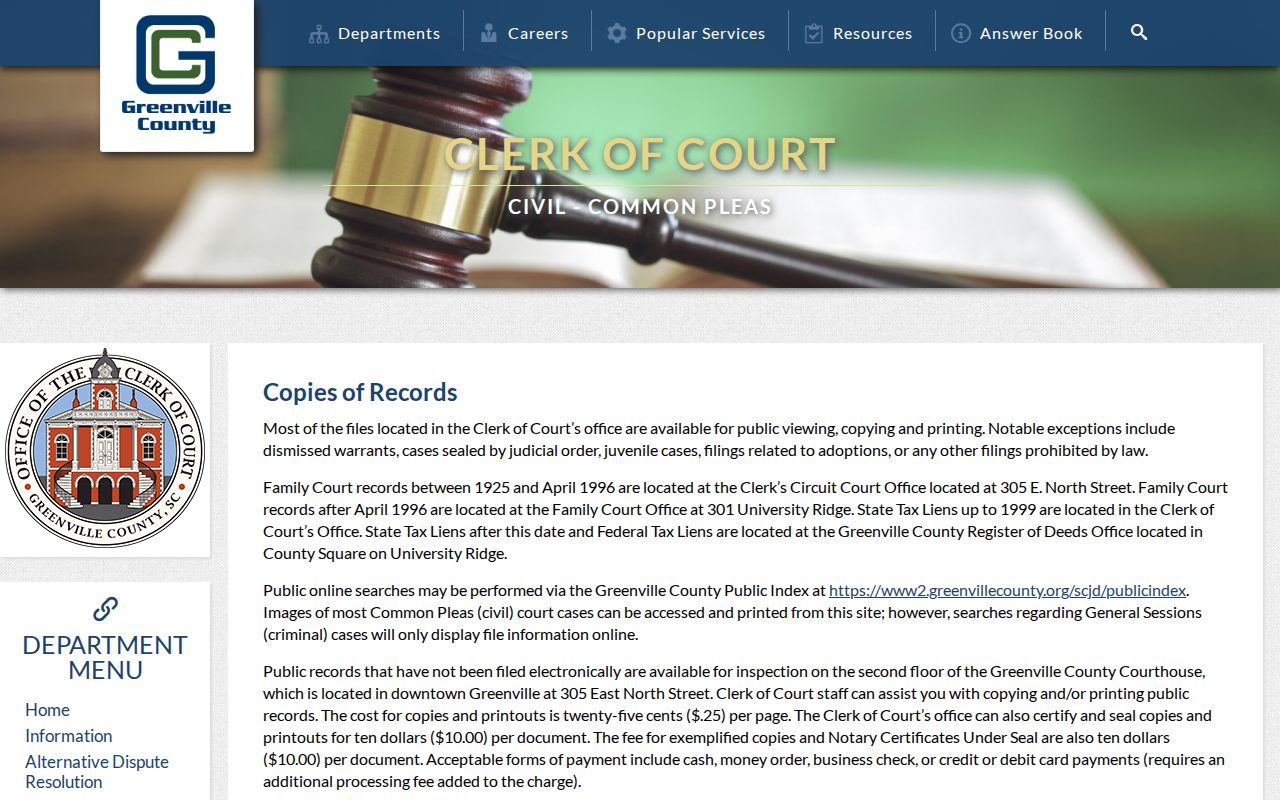
A court hit establishes public case context for an indexed party. It does not establish a current address, identity beyond the record’s details, or access to every image.
| Case number | The identifier used to request or distinguish a court file. |
|---|---|
| Court or division | The forum that helps separate Common Pleas, General Sessions, Family Court, and other matters. |
| Parties and role | The listed names and their relationship to the case, which matters when names are alike. |
| Dates and events | Filed, activity, and docket information that places the result in time. |
| Public image or order | Available material where the record category and access rules permit it. |
Greenville County Probate Heir Search
An heir question calls for probate records, not a general name guess. Greenville County Probate Case Search accepts a name, case number, and party type. The name field’s local example is surname first, and the case number can narrow a broad result. An estate, will, guardianship, or related filing may identify a decedent and parties, but any claimed relationship should be read from the accessible filing itself.
Records & Research supplies the copy route. The Probate Court asks requesters to provide the decedent’s name, case number, and exact document by email, fax, or phone, with payment by check or money order before release. Probate and will-book material is also part of the historic research path through the South Carolina Room, where the time period can be matched to the record rather than presumed from a current name.
Greenville County Probate Case Search is the official lead for estate names and case numbers in a focused resident lookup.
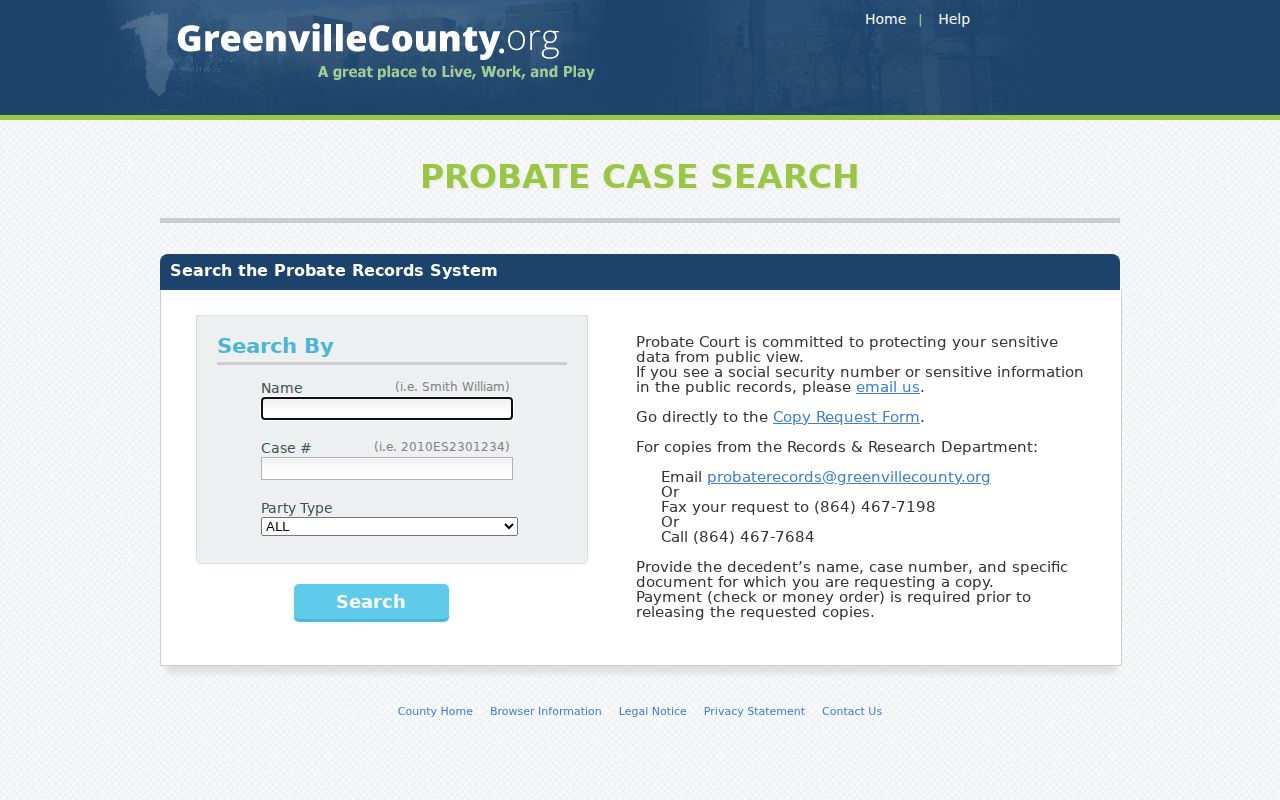
A probate search result points toward a case and custodian. It should be paired with the record date, party type, and any parcel or family-history evidence already established.
Greenville Vital Records in a Resident Lookup
Vital records have separate custodians and access periods. South Carolina DPH issues statewide birth, death, marriage, and divorce copies, while Greenville County Probate Court maintains local marriage licensing. Birth records become public after 100 years, and death records after 50 years. DPH describes different eligibility rules for certified copies, so an index reference and a certified record are not interchangeable.
For marriage research, the Greenville County Marriage License Search accepts Applicant Name, Applicant 2 Name, and an optional License Year. The County recommends a maiden name for the most accurate search. DPH’s current marriage heading routes July 1950 through December 2023 to the state, with requests before and after that span handled by the Probate Court where the license issued. This custodian split is essential when a resident lookup reaches a marriage event.
Greenville County Marriage License Search provides the local name-and-year route for a resident lookup.
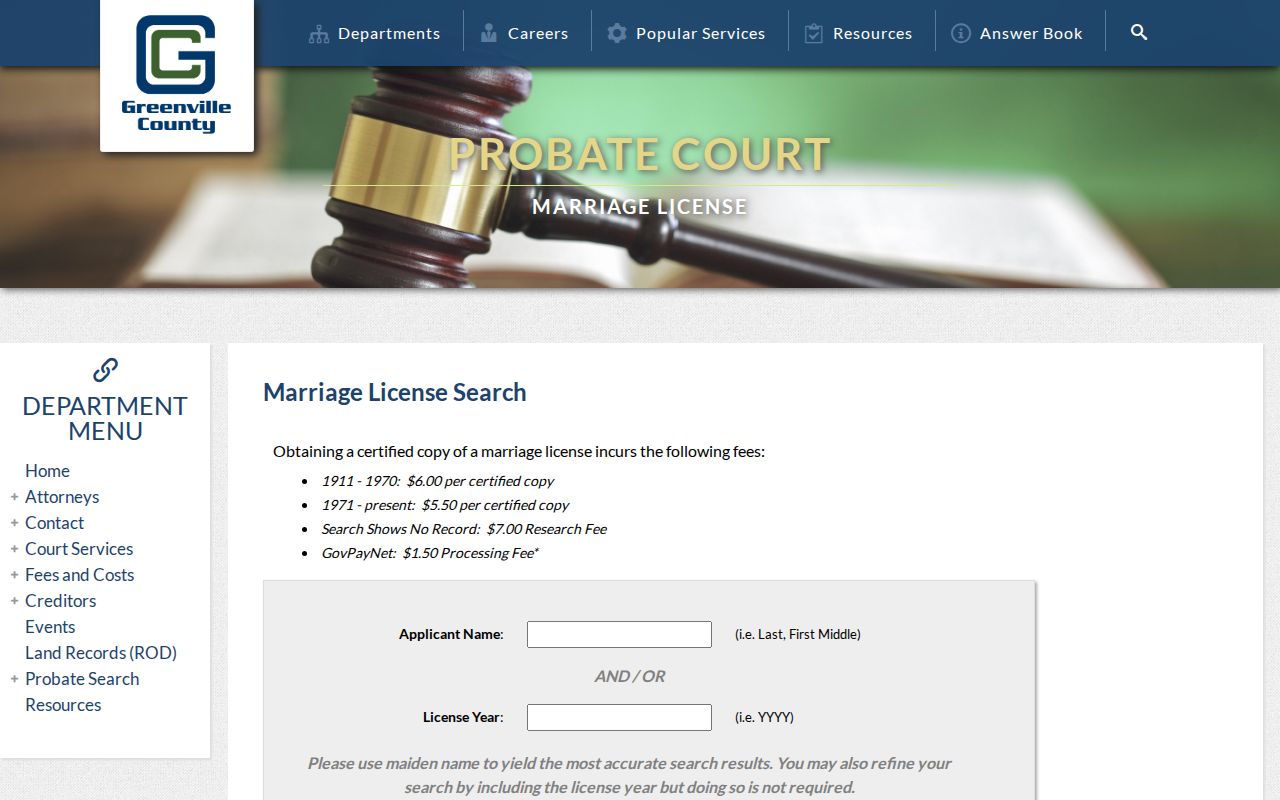
Public results can show the license number, both applicant names, date married, an opt-out status, and a copy-request path. The County processes online opt-out requests within its stated timeframe and asks users to report exposed sensitive information.
Greenville Voter Lookup Limits
MySCVotes Voter Information is a protected individual channel. It requires County, first name, last name, date of birth, and the last four digits of a Social Security number before it opens voter information. It is not an open name search and does not provide a browseable list of people at an address or on a street.
| Field | Format | Required | Local use |
|---|---|---|---|
| County | Dropdown | Yes | Select Greenville from the statewide county list. |
| First and last name | Text | Yes | Identifies the person entering the protected self-service channel. |
| Date of birth | mm/dd/yyyy | Yes | Required for authentication. |
| SSN, last four | Four-digit numeric entry | Yes | Required for authentication, not a public search field. |
Eligible registered South Carolina voters can use the State Election Commission’s lawful list-sale process, subject to its criteria and statutory conditions. Voter information may not be used for commercial solicitation under S.C. Code Ann. § 30-2-50. Greenville County registration staff also state that Social Security numbers supplied to the office are confidential and never published on a voter-registration list.
Greenville County Filing and License Leads
A public filing can be useful when it answers a narrow role question. The South Carolina Secretary of State Entity Search has a business-name field and a match-mode choice for Begins With, Contains, or Exact Match. A result can identify an entity and disclosed role, agent, or address. It does not establish where a named officer currently lives.
LLR Verify is the statewide route for regulated-license status. Where a board makes it public, a record may show license category, status, number, disciplinary link, or disclosed business information. The current universal field set was not verified, so a Greenville County resident lookup should not assume that every board offers the same filters or result details.
Greenville County Namesake Checks
Same-name errors are common in a resident lookup. Greenville County offers several local ways to narrow a match: ROD recommends surname-first searching, the marriage search advises a maiden name, Probate Search offers name, case-number, and party-type modes, and the GIS report adds a PIN, legal description, mailing address, and situs. Two records that share a parcel or dated event are more useful than a string of unrelated name hits.
For a historic person, use the correct period. The South Carolina Room holds city directories, newspapers, microfilm, and research tools; its Greenville News obituary index runs from 1901 forward and directs the reader to a date and page. An older address or obituary lead can also be developed through the past-residents record trail, where the parcel and deed sequence take priority over a current address assumption.
Note: Washington District, Pleasantburg, and Greenville can all be relevant locality terms in early Greenville County material.
Correcting Greenville County Records
South Carolina FOIA opens nonexempt records, but it does not create a general right to erase a valid record. The correction path belongs with the office that holds the data. Real Property Services handles an owner mailing-address correction. County or state election staff handle voter-registration updates. The original court or agency should receive a request about a public case or administrative record.
When an online route stops, make a focused request to the actual custodian. A court request should identify the case number, division, date range, and party role. A probate request needs the decedent’s name, case number, and exact document. For a local record with no verified public search, name the record type, period, and desired format in a written FOIA request instead of treating an unofficial compilation as the official source.
The Clerk and Register of Deeds have a no-fee written process for removing specified sensitive identifiers from an official-record image displayed online. The identified categories include Social Security, driver’s-license, state-identification, passport, bank-account, payment-card, PIN, and password numbers. The request must identify the page and can be delivered by mail, fax, electronic transmission, or in person. It does not remove a name, recorded ownership, or an entire court entry.
Lawful Greenville County Resident Research
Records can support family history, an heir search, a property question, civic research, or a scam check. They also have firm limits. Motor-vehicle personal information is restricted by federal law. Court files can be sealed or redacted. Current vital certificates follow eligibility rules. A professional or entity filing identifies the disclosed relationship in that filing, not a person’s present residence. Use the official record as a dated lead and verify material facts with its custodian.
Lawful use. Greenville County resident lookup research belongs to legitimate personal, family-history, heir, and civic purposes. Never use a record to stalk, harass, intimidate, monitor, or harm another person.