
Greenville County City Directory Shelves
Greenville County has several city directory collections, but each one has its own scope and gaps. The Greenville County Historical Society documents Greenville City Directories from 1883 through 2008. At Hughes Main, the South Carolina Room and its catalog identify Hill, R. L. Polk, later Polk, and Data Axle materials. A year listed in a catalog is useful evidence that a volume is held. It is not proof that every year between two listings exists. Confirm the exact year before a trip, especially when a search depends on a move between two census dates.
| Collection | Years | Where Held | Access |
|---|---|---|---|
| Greenville City Directories | 1883-2008 | Greenville County Historical Society | Appointment and research access; verify a volume first. |
| Hill's Greenville City Directory | Documented holdings through 1973 | GCLS South Carolina Room and catalog | Library-use-only listed volumes, with catalog gaps. |
| R. L. Polk: Greenville, City View, Taylors | 1983-1996, with gaps | GCLS catalog and South Carolina Room | Check the requested year before travel. |
| Polk Greenville, SC City Directory | 1997 onward | GCLS reference holdings | Later entries include Greenville and Pickens counties. |
| Data Axle / InfoUSA reverse directory | Annual from 2007 | GCLS reference | Library access required; availability should be confirmed. |
The Greenville County Historical Society also holds maps, papers, photographs, and Sanborn maps, so its directory shelf can be paired with local place evidence rather than read alone.
Note: Each Greenville County cataloged run identifies known holdings, not a promise of uninterrupted annual publication for every year.
Greenville County City Directory Publishers
Publisher changes matter because the coverage changes with them. Hill Directory Company is documented in the Hughes Main catalog through 1973, including listed library-use-only volumes from 1931, 1933, 1935, 1938, 1940 through 1945, 1946 through 1947, 1948 through 1965, 1967 through 1974, 1977, and 1980. The catalog does not turn those grouped listings into a complete annual sequence. R. L. Polk entries cover Greenville, City View, and Taylors in the documented 1983-1996 period, then the successor Polk record begins in 1997 with a Greenville-and-Pickens-county scope.
The publisher name, title, and stated scope should be copied into Greenville County research notes before comparing entries. A Greenville County listing in an older city-focused volume and a listing in a later county-paired title may be answering different geographic questions. A tentative Piedmont Directory Company Greenville title, including Woodside, is cataloged at about 1905 to about 1930. The uncertainty belongs in the citation, not in a claim that its run is exact.
- 1883: the Historical Society's documented Greenville directory run begins.
- 1931: the first specifically listed Hill volume in the Hughes Main catalog appears.
- 1983: the documented R. L. Polk Greenville, City View, and Taylors period begins.
- 1997: the successor Polk record begins with Greenville and Pickens counties in scope.
- 2007: the catalog documents an annual Data Axle / InfoUSA reverse-directory resource.
The Hill's catalog record is the source shown in this library record image.
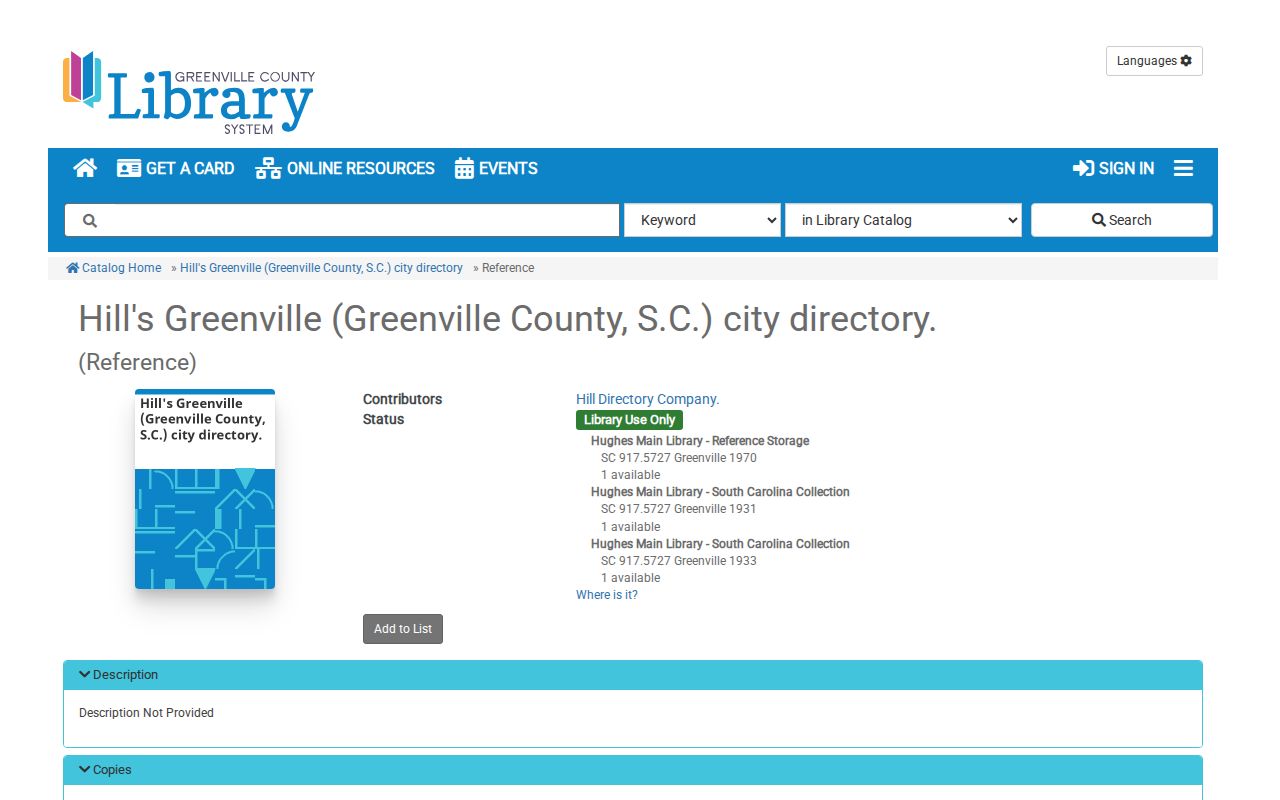
The catalog view is a useful starting point for selecting a volume, while the volume itself remains the source for its contents.
Greenville County City Directory Room Access
The South Carolina Room is the local bridge between a catalog result and the physical record. It focuses on Greenville County and surrounding Upstate history, recommends appointments, and provides databases, family files, manuscripts, maps, microform, newspapers, periodicals, photographs, reference books, research computers, study tables, and scanning equipment. Those options make it possible to compare a directory entry with the period's newspaper, map, or family file without treating one listing as final proof.
The library's genealogy resources identify in-library Ancestry and FamilySearch access, along with Fold3, HeritageQuest, HeritageHub, historic American newspapers, and a Greenville News collection from 1999 forward. Its County and State Records lesson says city directories can bridge census intervals and reveal addresses and occupations. A Greenville County library card or South Carolina Room visit may be needed for a particular licensed source.
Note: An address in a directory is a research lead and should be checked against the period's census, property card, or deed.
The library genealogy resources are shown in this source image.
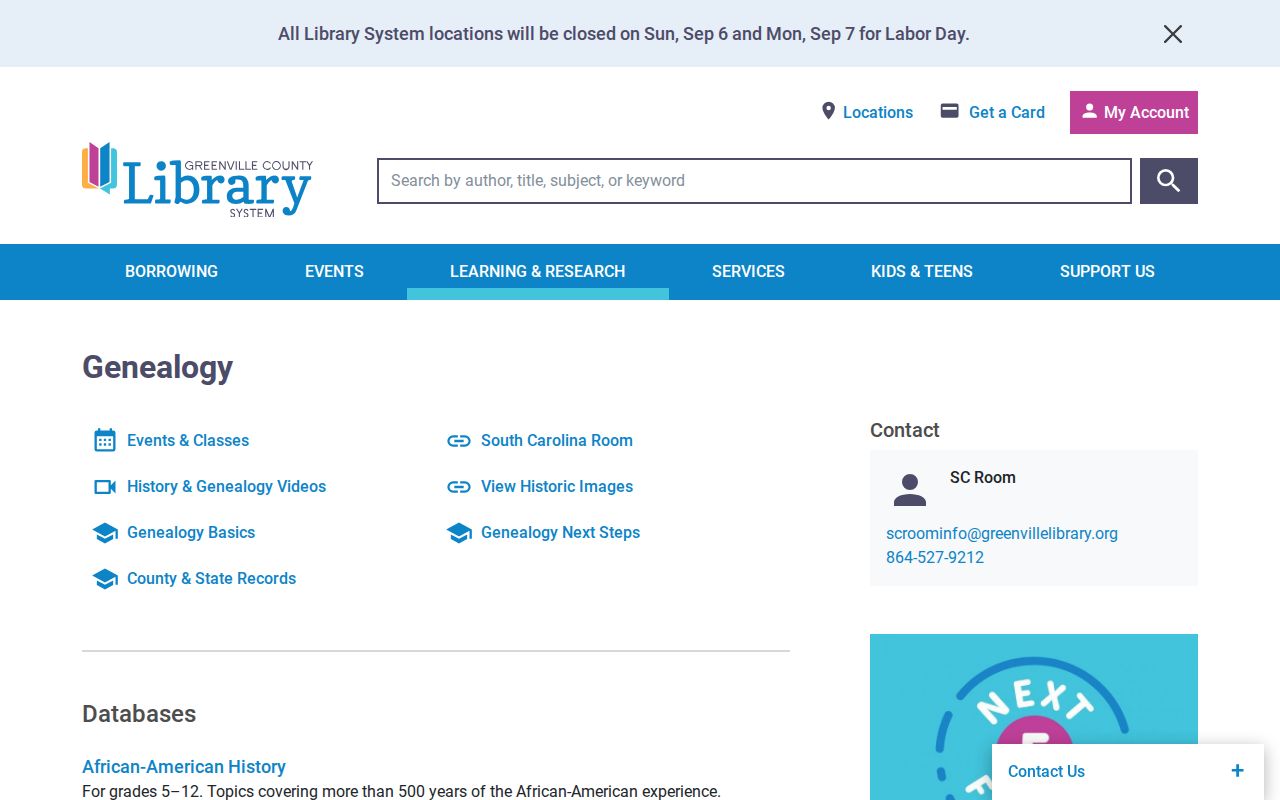
Library databases and room equipment add access routes, but the requested year and collection still determine what can be reviewed.
What Greenville County City Directories Verify
A locally held Greenville directory page and its abbreviation key were not available for direct inspection in the research. That limits the claims that can be made about a sample entry. The library verifies that local city directories can reveal addresses and occupations. It does not support transferring generic assumptions about spouse notation, owner marks, widow labels, or a particular abbreviation system into every Greenville County volume. Inspect the exact volume before transcribing fields or symbols.
| Verified local use | The library says city directories can reveal addresses and occupations. |
|---|---|
| Volume identity | Publisher, title, and year establish which collection and geographic scope were consulted. |
| Unverified entry details | Spouse notation, owner or renter marks, and abbreviation meanings were not inspected in a local page. |
| Best next check | Review the specific volume in the South Carolina Room or licensed collection and record what that edition displays. |
- Criss-cross directory
- A reverse or cross-search directory arranged for address-based research. Greenville has a documented Data Axle / InfoUSA reverse-directory resource from 2007, but its local printed layout was not inspected.
- Householder index
- An index arranged under a household name when a particular volume uses that format. Its use in a Greenville edition must be verified in that volume.
- Abbreviation key
- A page that explains a volume's shorthand, if the volume includes one. No locally inspected Greenville key supports a universal reading.
Greenville County Polk Directory Changes
The Polk catalog records are especially helpful for a late twentieth-century Greenville County search. One record documents R. L. Polk editions for Greenville, City View, and Taylors from 1983 through 1996, with gaps. A successor record begins in 1997 and includes Greenville and Pickens counties. That scope change is a reason to read the title page and catalog note before treating two adjacent editions as like-for-like evidence.
The R. L. Polk catalog record is represented by this source image.
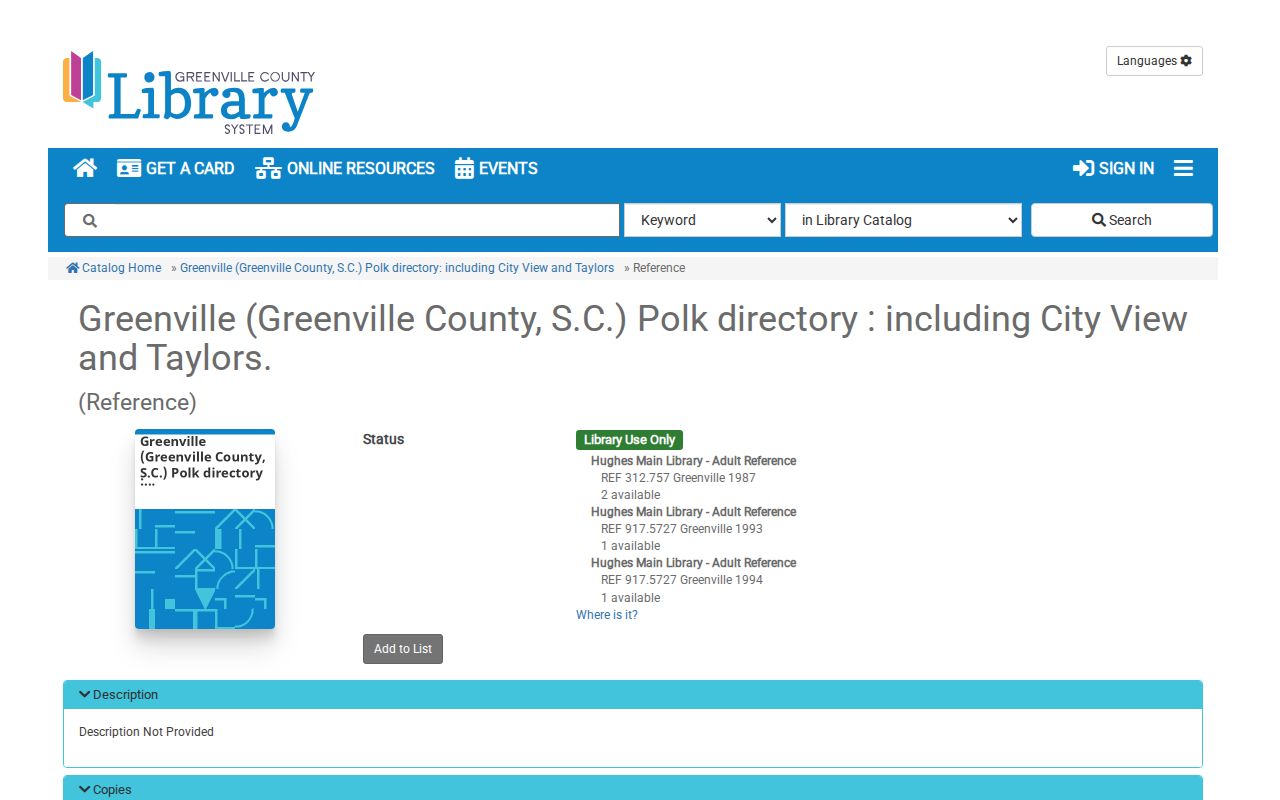
The image documents a catalog access route. It does not fill the catalog's stated gaps or establish that an omitted year is unavailable everywhere.
The later Polk Greenville and Pickens record appears in this source image.
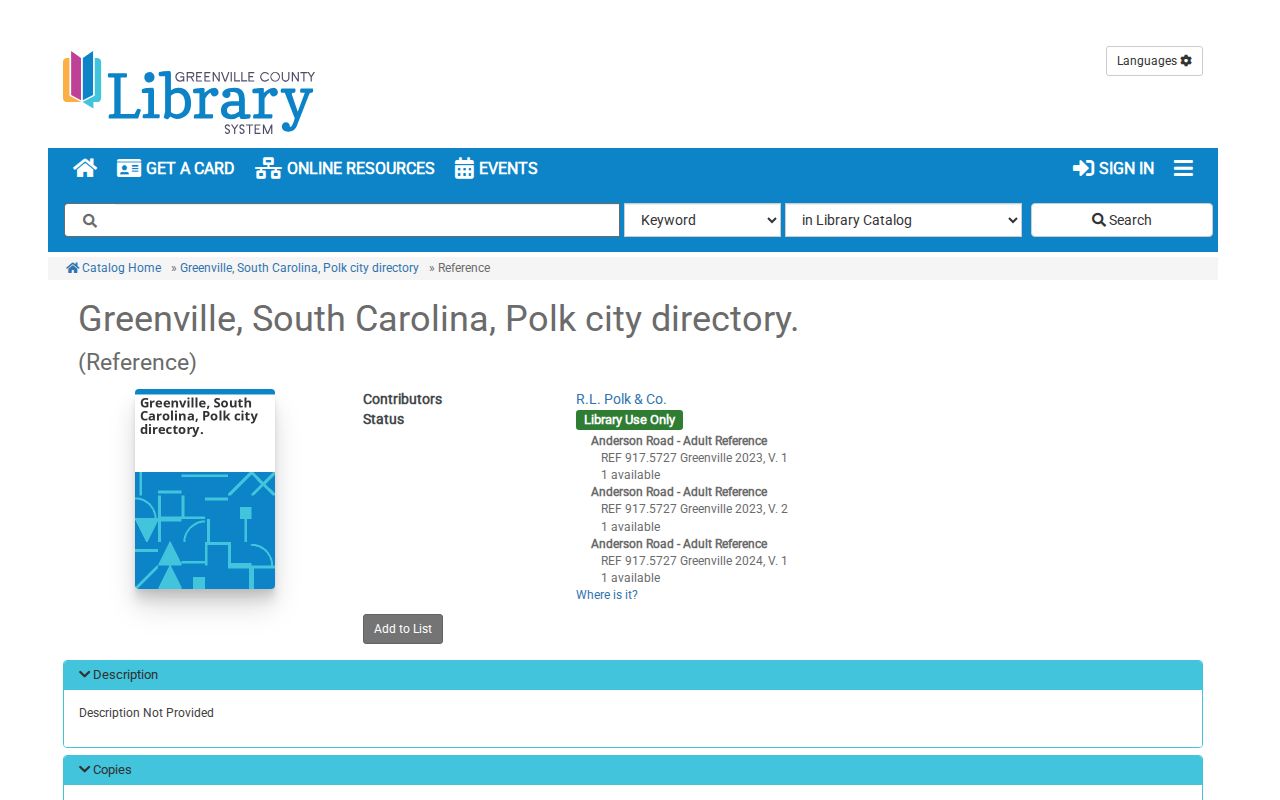
A broader later title can help locate a household after a move, while an older city directory may be better for the earlier address.
Greenville County City Directory Cross-Searches
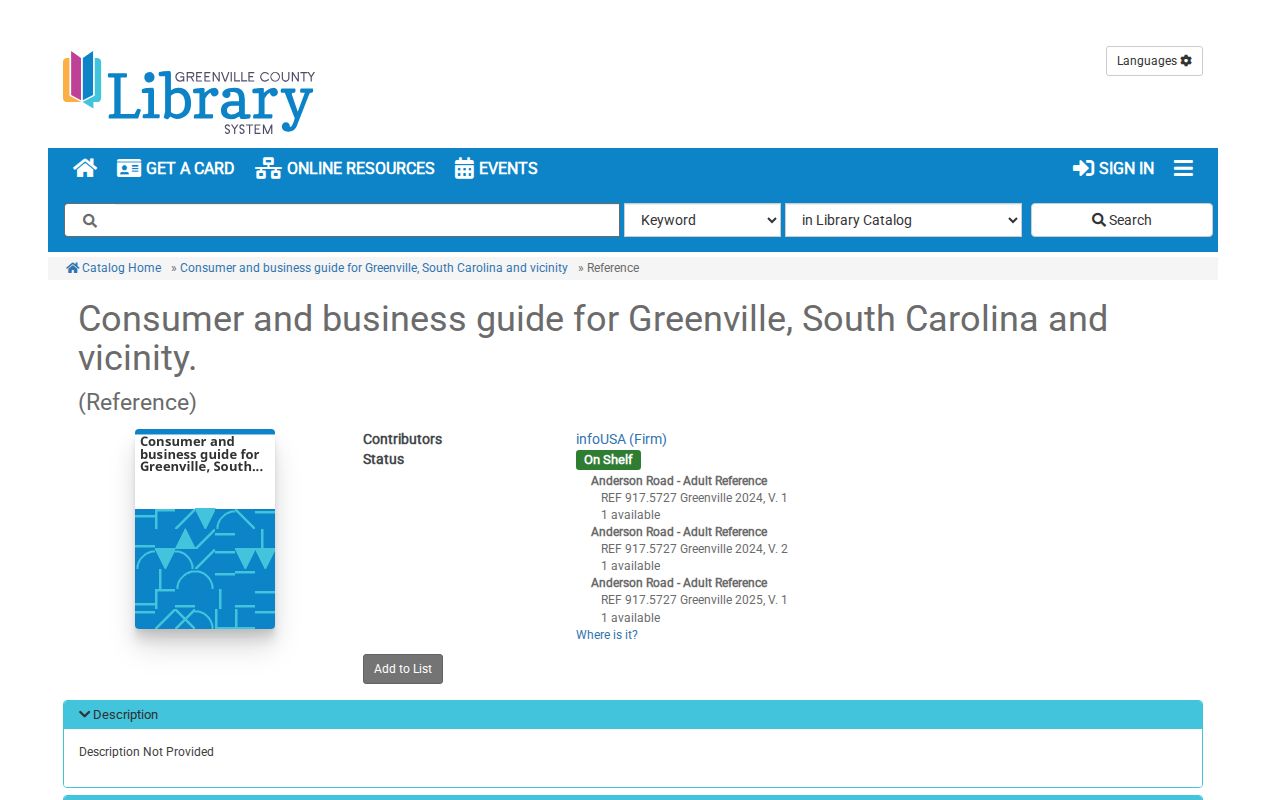
The Data Axle / InfoUSA catalog record documents an annual reverse or cross-search telephone directory from 2007. That makes it a distinct Greenville County city directory tool from the named-person volumes. The catalog does not establish continuous earlier reverse coverage or a local page layout. Reserve Greenville County library access, request the exact year, and compare any returned address-name connection with a property record or recorded deed from the same period.
The Data Axle / InfoUSA record is the source for this library image.
A reverse-directory result is best used to form a dated address lead, not to make an unsupported claim about ownership or a full household.
Greenville County City Directory Map Companions
When a Greenville County directory address changes form, the local house-history sources can keep the place in view. The library guide identifies city directories at SC 917.5727 and points to city-directory collections in Ancestry Library Edition and HeritageQuest. It also identifies the 1923 and 1924 City Block Book in South Carolina Room microfiche 333.3 CITY. The Block Book and a deed's legal description can bridge a block or lot when a modern street number does not fit an older record.
Sanborn maps add building and location chronology, not a person index. GCHS documents City of Greenville Sanborn maps from 1920 through 1951, while the guide points to University of South Carolina digitized maps and South Carolina Room microfilm and physical access. Current property cards, Register of Deeds deeds and plats, maps, and the Block Book work as companions because each answers a different question about the same place.
Greenville County City Directory News Trails
A Greenville County directory find can lead into the local newspaper chain. The Greenville News obituary index covers 1901 to the present and directs a researcher to a date and page. The South Carolina Room has microfilm for retrieving that cited article. The marriage-announcement index covers Greenville News material from 1990 forward and TOWN material from 2011 through 2023. Those dates and pages are search aids, not substitutes for reading the underlying item.
The County and State Records lesson also points researchers toward historical property cards, deeds and plats, probate and will books, state death certificates, land-ownership maps, and archives. A directory entry, a dated article, and a county record can reinforce one another when they match on place and time.
Trace Greenville County City Directory Households
Use a dated Greenville County sequence rather than reading a city directory as a permanent portrait. Begin with a specific volume and record the title, publisher, and address or occupation information that it actually supplies. Pair that volume with the nearest released federal census year. Then compare the property record and deed citation before moving one directory volume backward or forward. This process keeps a name, address, and record date together even when the collection has missing years.
- Locate the person or address in an identified Greenville volume and save the volume's year and title.
- Check the nearby federal census year that is released under the 72-year rule.
- Compare the address with the relevant property card and recorded deed or plat citation.
- Move one available directory volume backward or forward, noting a change in address, locality label, or scope.
- Use the obituary index, probate material, or other dated record to test a disappearance or family connection.
A person can disappear from a volume for many reasons, including a move, death, a changed coverage area, or an omission. Only another dated record can distinguish those possibilities. Modern address-keyed property work belongs with the Greenville County by-street directory when the question turns from a historical household to a current parcel trail.
Note: Keep the title, date, page, and locality label with every transcription so later checks can return to the same record.
Greenville County City Directory Historic Labels
Early Greenville research needs more than the modern place name. Greenville County was created in 1786 from former Cherokee territory, was part of Washington District with Pendleton from 1791 through 1800, and had a county seat called Pleasantburg before the name Greenville was adopted in 1831. Catalogs, judgment-roll indexes, deeds, and other early material can therefore use Washington District, Greenville District, Pleasantburg, or Greenville.
The County Historical Records collection says Washington District and Greenville District judgment-roll papers are sporadically interfiled and cannot be separated without disrupting the original filing order. Search both historic locality terms with a party name and date where the period fits. This local quirk is a useful safeguard when a historical directory trail reaches into county records that predate the modern label.
Greenville County City Directory Archive Context
The Greenville County Historical Society adds context beyond the directory shelf. Its resources include maps from the 1880s, bound Sanborn maps, personal papers, books, journals, ledgers, newspapers, manuscripts, and more than 5,000 historic photographs dating from the 1890s through the mid-twentieth century. A map, caption, ledger, or family paper can guide a search toward a deed, probate file, census, or directory volume, but it should be cross-checked against the record that supports the date or identity.
The Society's Vardry McBee collection contains roughly 850 items from 1786 through 1934 in 33 series, including land grants, deeds, plats, business records, letters, accounts, and tax receipts. Fragile originals may require onsite research. The County's historical digital images also exist on microfilm in the South Carolina Room, providing a practical continuation when an online image is unclear or incomplete.